

Although it is now easy to make an appointment with a psychologist, particularly in larger cities, this does not necessarily mean that the psychologist is right for you. It is very common for a patient to decide to end their therapy after one or two sessions because they realise that the psychologist’s approach does not suit them.
One of Yachay’s missions is to address this problem by offering a patient / psychologist matching tool.
Finding a psychologist has become simple
For a long time, looking for a psychologist mainly involved a personal recommendation or a referral from a doctor. These routes remain useful, but they are no longer the only options. Today, with the growth of digital services and appointment-booking platforms, you can make an appointment with a psychologist in just a few clicks.
Online sessions have also widened the possibilities. They allow you to meet a psychologist without limiting your search to practices near your home. This flexibility may be useful when travelling is difficult, your timetable is restricted or you want sessions in a language that is less widely offered in your area. Some people also attend their session in a park or from their sofa at home. For some patients, this has helped to “demystify” the psychologist’s office and show that therapy can take place in different settings.
The number of ways to search has therefore increased. The main challenge is no longer simply finding a professional, but identifying which available profiles might genuinely suit you.
Clarify your expectations
You do not need to understand the exact origin of your difficulties before asking for help. A useful first step is simply to put a few words around what is leading you to consider a consultation. You might be going through anxiety, exhaustion, bereavement, relationship difficulties or the effects of a traumatic experience. You may also want to understand yourself better without being able to name one specific problem.
Other practical criteria can shape your search:
- the language or languages in which you want to express yourself;
- whether you prefer online or in-person sessions;
- the city and distance you are prepared to travel;
- your maximum budget;
- your availability;
- any preference you may have regarding the psychologist;
- the importance of reimbursement or agreed healthcare rates.
These points are not secondary. A session that is difficult to reach, too far away or incompatible with your budget may be hard to maintain over time. Including these criteria from the start helps produce a more realistic selection.
You can also learn about therapeutic approaches. You do not need to become an expert or choose a method on your own before the first appointment. Understanding the broad principles can, however, help you see why some profiles may be more relevant to your search.
Cognitive behavioural therapy, or CBT, focuses in particular on the interactions between thoughts, emotions, physical reactions and behaviours. The work is often structured around goals agreed with the therapist. Observation exercises or practical activities may form part of the support.
EMDR follows a different process. It is used by trained professionals, notably to support people with certain effects of traumatic experiences or distressing memories. It follows a specific protocol and involves more than the eye movements that are often mentioned when the approach is introduced.
It can therefore be useful to learn about certain therapeutic approaches beforehand, so you have an initial idea of what you would like to work on with the psychologist. However, this is not necessary in every case.
Use Yachay to find the psychologist who is right for you
Yachay offers a matching tool for patients and psychologists to make this first search clearer.
The questionnaire lets you describe why you would like to consult, who needs support, any therapeutic preferences and the languages you want to use during sessions. It also considers the consultation format, location when you want in-person sessions, acceptable travelling distance, budget and other practical preferences.
Based on these answers, Yachay searches for psychologists whose profiles are closest to the criteria you expressed. A score out of 100 is assigned. The closer the score is to 100, the better the psychologist suits you. You can then book an appointment directly with the psychologist or contact them through our internal messaging system.
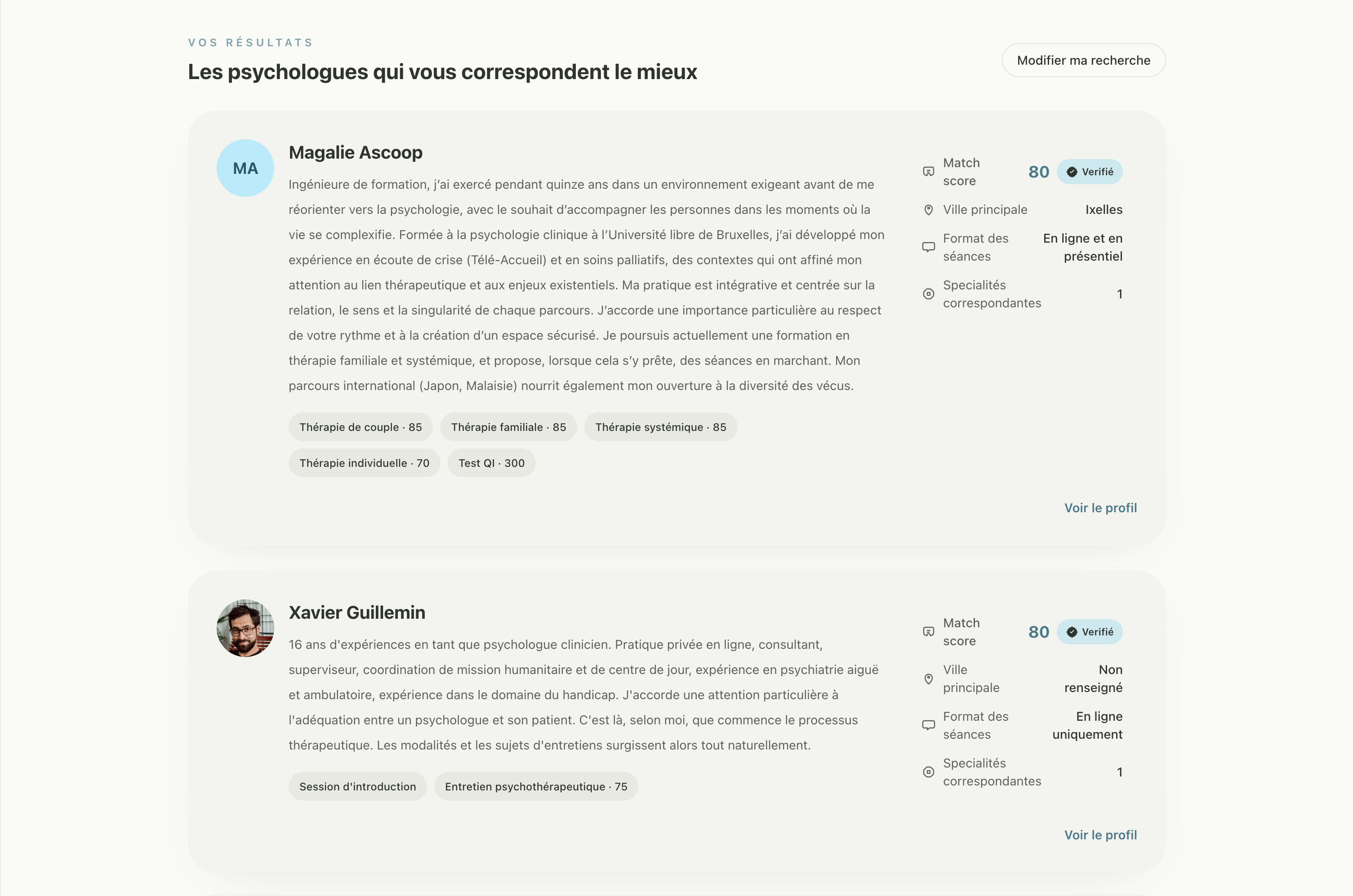
This process is also useful for psychologists. They receive requests from patients that are aligned with their practice. This avoids unnecessary first appointments or therapy ending after two sessions.
Take the first step more simply
Yachay therefore helps you quickly find the psychologist who is right for you.
Some psychologists on Yachay also offer an introductory 10- to 15-minute session to get to know each other and check whether the match is confirmed in practice.