
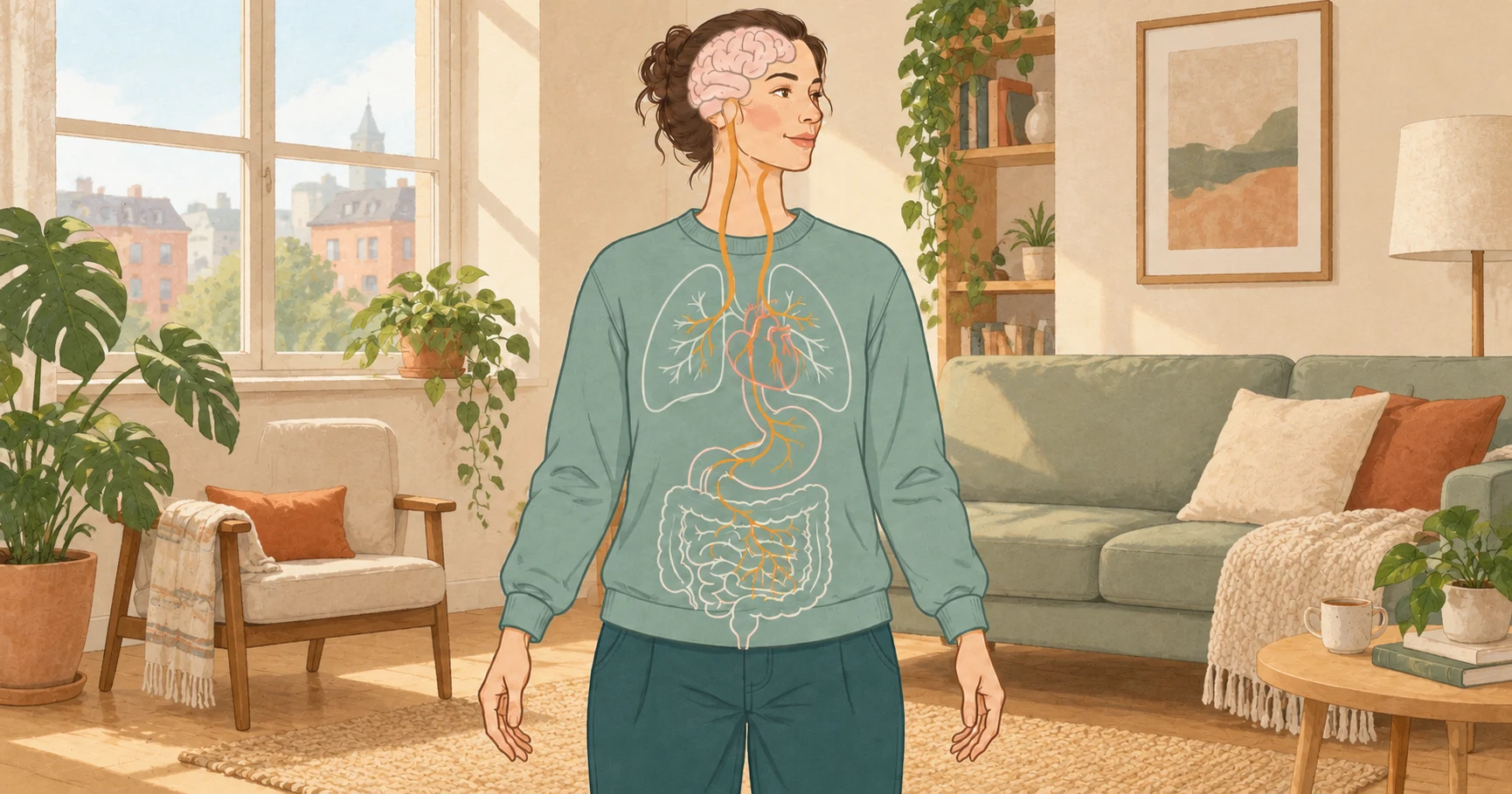
Breathing, anxiety, stress, sleep… In recent years, the vagus nerve has been everywhere. On social media, some people present it as the key to finding calm, managing emotions better and even overcoming trauma. But what does science actually say?
A quick search on Instagram, TikTok or YouTube brings up hundreds of videos about the vagus nerve. Some promise to reduce stress in a matter of minutes through breathing exercises. Others explain how to “stimulate” this nerve to improve sleep, reduce anxiety or restore emotional balance.
Behind this enthusiasm lies a real scientific subject: the constant communication between our brain and our body. So, is the vagus nerve as important as people claim? And, above all, can we really influence it to improve our mental health?
What is the vagus nerve?
The vagus nerve is one of the most important nerves in our body. Its name comes from the Latin vagus, meaning “wandering” or “roaming”. This name reflects its route: it starts in the brainstem and passes through the neck, chest and abdomen, where it communicates with several of our organs. It is involved in regulating heart rate, digestion and certain aspects of breathing.
But what makes it distinctive lies elsewhere: it allows two-way communication between the brain and several organs. In other words, our brain sends information to our body, but our body also sends information to our brain.
The vagus nerve is part of the parasympathetic nervous system, which contributes to rest, digestion and recovery. To understand its role, we need to look at the autonomic nervous system, which regulates many functions without us having to think about them. It includes two major components:
- The sympathetic nervous system, which helps prepare our body to respond to a demanding or threatening situation.
- The parasympathetic nervous system, which helps support rest, recovery and digestion.
These two systems are not simply opposing switches. They interact constantly to help our body adapt to the situations we encounter.
What is the link between the vagus nerve and stress?
Imagine having to speak in front of a hundred people. Your heart beats faster, your breathing changes, your hands become clammy and your stomach tightens. These reactions are not only psychological. They are physiological too.
When a situation is perceived as stressful, our body mobilises different mechanisms to help us respond. The sympathetic nervous system plays an important role in this process. Once the situation has passed, other mechanisms help us return to a resting state. The vagus nerve is involved in regulating heart rate.
It is precisely this link between physical reactions and emotions that interests researchers. Our emotions influence our body, and information coming from our body can also influence our emotional experience. It would be incorrect, however, to claim that the vagus nerve alone controls our stress or anxiety. These experiences involve many mechanisms in the brain, hormones, physiology and psychology.
Why is the vagus nerve getting so much attention today?
The vagus nerve is not a recent discovery. Scientists have been studying it for a long time. Its current popularity is better explained by several developments coming together.
Growing interest in the connection between body and mind
For a long time, the general public mainly associated mental health with thoughts, emotions and behaviour. Today, approaches that explore interactions between the brain and the body are becoming more visible. We have a better understanding of why stress can be accompanied by abdominal pain, muscle tension or changes in heart rate. The vagus nerve has become one of the symbols of this relationship between physical and psychological experiences.
The popularity of polyvagal theory
Another explanation comes from polyvagal theory, developed from the 1990s onwards by the American neuroscientist Stephen Porges. This theory proposes a model linking different responses of the autonomic nervous system to our sense of safety, our social behaviour and our reactions to danger. It has become popular in some areas of psychotherapy, particularly in work with people who have experienced trauma.
However, polyvagal theory has attracted significant scientific criticism. In February 2026, a paper co-authored by 39 specialists challenged several of its neurophysiological and evolutionary foundations, arguing that some of its central claims are not supported by current scientific knowledge. Stephen Porges published a response disputing this analysis.
It is therefore important to distinguish between two things: the well-established physiological role of the vagus nerve and the interpretations put forward by polyvagal theory, several aspects of which remain controversial.
The influence of social media
On social media, scientific explanations are often simplified. The vagus nerve is sometimes presented as a button that could be activated to make stress disappear instantly. This idea is appealing: it suggests that a few exercises might be enough to regain control of our emotional state. But our nervous system is far more complex.
Can the vagus nerve really be stimulated?
The answer is yes, but we need to distinguish medical techniques from wellbeing exercises.
Medical vagus nerve stimulation
Vagus nerve stimulation is a genuine medical technique. It uses a device that delivers small electrical impulses to modify the activity of certain nerve pathways.
This approach is used in some patients with epilepsy that does not respond to medication. It may also be offered in particular cases of treatment-resistant depression, depending on the medical indications and applicable regulations. Non-invasive devices, which do not require surgical implantation, are also being studied.
These medical applications show that the vagus nerve can indeed be a therapeutic target. But this does not mean that every technique claiming to stimulate it has the same effects.
Breathing exercises
Slow breathing is one of the techniques most often associated with the vagus nerve. And, unlike some far-fetched claims, its physiological effects have been studied.
A scientific review published in 2024, covering 31 studies and 1,133 participants, found that slow breathing could produce short-term effects on several cardiovascular measures, including heart rate and heart rate variability. The effects on negative emotions and stress were more modest and less certain.
This does not mean that breathing exercises are useless. They can be a simple way to encourage relaxation for some people. But feeling calmer after a few minutes of breathing does not prove that you have “reset” your vagus nerve.
What about cold showers, singing or massage?
There are also many recommendations involving cold exposure, singing, humming or certain types of massage. These practices can bring about different bodily reactions. Some may also create a feeling of relaxation.
However, there is not enough scientific evidence to claim that they all effectively stimulate the vagus nerve or that they can treat anxiety, depression or trauma. Be particularly wary of videos promising an immediate transformation of the nervous system.
Can the vagus nerve treat anxiety or trauma?
This is probably where the claims become most problematic. Anxiety, depression and trauma-related disorders are complex phenomena. They cannot be reduced to the dysfunction of a single nerve. Their development and persistence can involve personal history, the environment, life experiences, psychological processes and different biological mechanisms.
Although some body-focused interventions can help reduce the physical manifestations of stress, there is no solid evidence that simple vagus nerve stimulation exercises heal psychological trauma. This does not mean that we should set body and mind against each other. On the contrary, their interaction is a particularly interesting area of research. But relaxation exercises do not replace appropriate psychological support when someone is experiencing persistent difficulties.
So, a scientific discovery or a wellness trend?
In reality, a little of both. The vagus nerve is an essential part of how our body works. Its role in communication between the brain and the organs is scientifically established. Research into it also opens up interesting possibilities in medicine and in understanding the interactions between physiological functions and mental health.
However, its popularity has encouraged many claims that go beyond the available evidence. There is an important difference between saying that a breathing technique can help with relaxation and promising that it can heal trauma by activating a nerve.
The real value of the vagus nerve is not that it offers a miracle solution, but that it reminds us how closely our mental and physical health are connected. Perhaps that is what we should take away: understanding more about how our body works can help us make sense of some of our reactions, without reducing the complexity of our emotions to a single biological mechanism.
Looking for support with stress or anxiety?
Relaxation techniques can be useful in everyday life, but understanding what you are going through on your own is not always easy. If stress, anxiety or difficult experiences are affecting your daily life, talking to a psychologist can help you better understand your emotions and find strategies suited to your situation. On Yachay, you can look for a psychologist who matches your needs, preferences and situation.