

An entire day can now pass without a real conversation. We work from home, scan our groceries at a self-service checkout in a supermarket, order dinner on a screen and exchange a few quick messages with friends on the other side of the world. Yet, by evening, a strange feeling sets in: I haven’t spoken with anyone today, I feel lonely.
The feeling of loneliness can arise even when we are surrounded by many people. It can emerge within a family, in a relationship, at the office or in the middle of a busy group chat. But where does this feeling of loneliness come from? How did we get here? Do our modern ways of life encourage isolation? How can we find relationships that matter?
The human being: a social animal
Human beings need one another. For much of our history, belonging to a group helped people find food, stay safe, raise children and pass on knowledge. Worse still, for a very long time, being isolated was viewed with suspicion, and only certain people, such as monks, had the possibility of living alone.
The World Health Organization defines loneliness as a painful feeling that arises when there is a gap between the relationships a person has and those they want or need. Loneliness is not simply about numbers. Ten acquaintances do not necessarily replace one person with whom we can be ourselves. Conversely, a small circle can feel deeply sustaining.
A study involving 40 adults offers a striking picture of this need. After ten hours of complete isolation, participants reported craving social contact. When they viewed images of people socialising, parts of the brain involved in motivation responded in a way comparable to their response to food after fasting. This study shows that a lack of social interaction triggers the same response in the brain as hunger. This means that social interaction could be a fundamental need, like eating. We therefore need to socialise to feel well. As social animals, isolation goes against our needs.
Being alone and feeling lonely are not the same thing
Social isolation and loneliness are often treated as synonyms. Social isolation describes an observable situation: having few contacts, social roles or interactions. Loneliness is an inner experience. The two can overlap, but they do not always do so.
Someone may live alone, enjoy the quiet of their home and maintain a handful of strong relationships. Another person may share daily life with several people and still feel that no one understands them. A person can also be surrounded during a demanding transition — starting university, becoming a parent or joining a new workplace — without finding the quality of presence they need.
Chosen solitude can be restorative. Reading, walking, creating, daydreaming or simply being unavailable for a while can help us recover and hear our own thoughts. Learning to be alone may support autonomy and make relationships feel freer: we no longer expect every encounter to fill an urgent emptiness.
Loneliness becomes painful when it is unwanted, persistent or far removed from the life we would like to have. A useful question is therefore not only “How many people do I see?” but also “Can I feel heard, recognised and at home in my relationships?”
How modern life has moved the places where people meet
Loneliness did not appear in the twenty-first century. Bereavement, exile, rejection and the feeling of being different have always existed and contributed to loneliness. However, it seems that current ways of meeting do not necessarily foster connection.
For a long time, most people lived close to their families, or even in the same house. With the individualisation and globalisation of society, things changed and meeting places evolved. The family structure gradually broke down, as did the role of religion, which once provided a meeting place for future couples. Today, only online encounters are increasing, at the expense of all other settings such as work, bars, circles of friends and the neighbourhood.
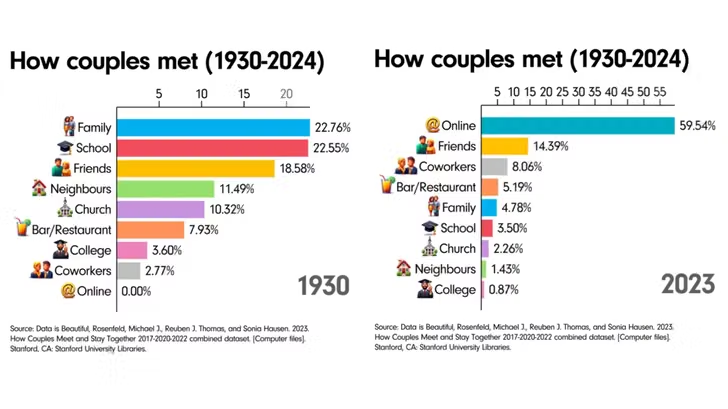
At the same time, some ordinary encounters have faded. Sociologists sometimes call them weak ties: the neighbour we greet, the colleague we meet by the coffee machine, the shopkeeper who recognises us, the regulars at a café or the parents waiting outside a school. These exchanges do not all become friendships, but they give the day a social texture. They quietly remind us that we belong somewhere.
Digital services make life easier while occasionally removing these micro-connections. It is possible to have food delivered, work, watch a film and complete an administrative task without speaking to anyone. The speed of daily life also leaves less unstructured time for relationships, even though relationships need repetition, attention and moments that produce nothing measurable.
Loneliness: a global epidemic
In 2025, the WHO estimated that about one person in six worldwide, or 15.8% of the population, felt lonely. Adolescents and young adults reported particularly high rates. Loneliness is therefore not only a concern in later life.
In Belgium, in the first quarter of 2026, Statbel reported that 7.1% of respondents, aged 16 to 74, felt lonely all or most of the time.
The phrase “loneliness epidemic” helped draw attention to the issue, especially after the Covid-19 lockdowns. This epidemic affects everyone, both people living in rural areas and those living in large cities, across all age groups.
When the brain shifts into protection mode
Persistent loneliness can change how we interpret what happens around us. When someone feels excluded for a long time, their brain may become more alert to possible rejection: a late reply looks deliberate, a neutral expression seems hostile, and a forgotten invitation confirms the belief that they do not matter.
This vigilance has a protective logic. If the group is vital, separation from it represents a threat. The problem is that this state of alert can reinforce the very situation it is trying to prevent. Expecting disappointment, we speak less, turn down an invitation or remain guarded. Other people may read that caution as disinterest. The distance grows, strengthening the conviction that we are on the outside.
An American study using data from the Framingham social network observed that loneliness tended to cluster within networks and appeared more often at their edges. Its authors used the language of “contagion”. Because the research was observational, this does not mean that a lonely person transmits loneliness like an illness. It suggests instead that our relational states influence one another and that exclusion can gradually weaken several connections. The humane response is to reach towards people at the margins, not to avoid them.
Loneliness affects mental and physical health
Loneliness is associated with more symptoms of depression and anxiety and a lower quality of life overall. The relationship may run both ways. Depression can lead a person to withdraw, while isolation may further darken their mood. Social anxiety can make encounters exhausting, while a long absence of contact may reinforce the fear that we no longer know how to connect.
Loneliness can also affect sleep. A systematic review of 27 studies found an association between loneliness and greater sleep disturbance. The direction is hard to establish: poor sleep makes us more emotionally vulnerable, while feeling socially unsafe may interfere with deep, restorative rest.
Over time, weaker social relationships are associated with a higher risk of mortality. A meta-analysis of 148 studies involving more than 300,000 people found that participants with stronger relationships had better odds of survival. The authors compared the statistical size of this association with established health risks.
The social media paradox
We have never been so connected. Yet loneliness seems never to have been so prevalent in our society. Social media can help people discover a community, discuss topics and reach out to others, but it does not necessarily encourage encounters or social connection. Worse still, it can sometimes create social pressure and anxiety.
How can we gradually move out of loneliness?
There is no universal recipe for no longer feeling lonely. Suggesting that someone should “get out more” is not necessarily a good approach. When energy is low, rejection feels frightening or social habits have faded, a crowded evening with strangers may not be the right first step. Connection is often rebuilt through smaller, repeatable movements.
Identify what is actually missing
Loneliness can point to different needs: an intimate conversation, a group to belong to, affection, ordinary daily contact, companionship through a difficult period or simply more familiar faces. Naming what is absent makes it easier to choose an appropriate action. A group activity may answer a need for belonging; calling one trusted person may be more helpful when we need to confide in someone.
Choose regularity over intensity
Relationships rarely grow from one spectacular meeting. They develop because the same people meet week after week in a setting where conversation gradually becomes natural. A team sport, a class, a choir, a creative workshop, a walking group, a neighbourhood association or volunteering can provide that repetition.
The best choice is not necessarily the most obviously “social” activity. It is one that feels appealing enough to attend for long enough that faces become familiar. Making attendance the first goal, rather than expecting to make a friend immediately, reduces pressure.
Give small connections their value back
Not every contact needs to become deep. Greeting a neighbour, exchanging a few words with a shopkeeper, sometimes working in a shared space or having coffee with a colleague can already ease the feeling of invisibility. Weak ties do not replace intimacy, but they rebuild a human environment around us.
Use digital tools as a bridge
When used wisely, digital tools can help people discover local communities, activity platforms and friendship apps that make meeting others easier. Meetup and some Facebook groups offer this.
Build connection even when working remotely
When remote work takes up much of the week, contact no longer happens by accident. It may need to be made possible: planning lunch with someone, spending a day in a shared workspace, preserving informal time with the team or taking a walk when the neighbourhood is active.
Allow closeness to take time
Sometimes, early interactions may feel awkward or tiring. This does not mean we have become incapable of connection. Social habits return through experience. A small gesture that can be repeated is often more helpful than a dramatic effort that cannot be sustained.
When might speaking with a psychologist help?
Professional support may be useful when loneliness lasts, causes significant distress or comes with anxiety, low mood, increasing withdrawal or loss of interest in daily life. A psychologist cannot build a social network on someone else’s behalf. They can, however, provide a relationship in which to understand what is happening and prepare realistic changes.
Cognitive behavioural therapy may help people notice automatic interpretations — “nobody wants me there”, “I will only be a burden” — examine them and gradually reduce avoidance.
Therapeutic work can also help people understand what fuels loneliness: fear of rejection, experiences of separation, lack of confidence, difficulty expressing their needs or the feeling that they never truly belong. Putting these experiences into words helps people better understand how they relate to others.
With a psychologist, it also becomes possible to prepare concrete changes: gradually reconnecting with certain people, joining an activity, learning to start a conversation, setting boundaries or building more reciprocal relationships. The goal is not to multiply contacts, but to create relationships in which a person can feel heard, recognised and at home.